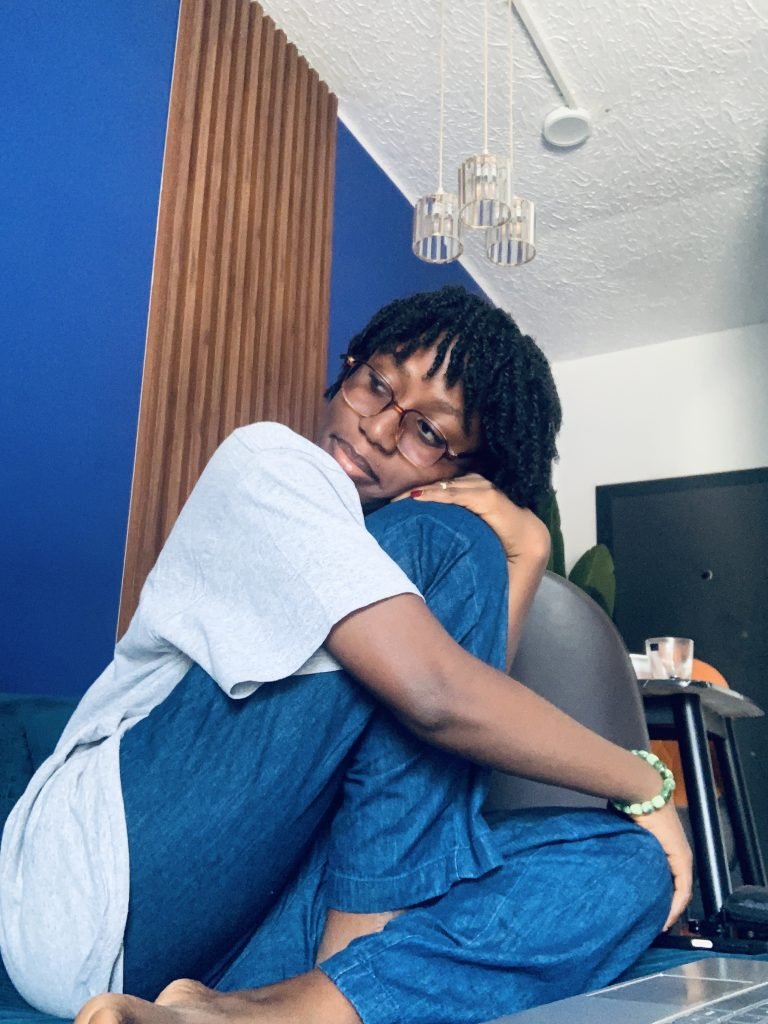

This interview features multidisciplinary Nigerian artist Testimony Odey in conversation with The Iroko Circle, where she reflects on her relationship with various art forms, including fiction, poetry, film, music, painting, and beadcraft. She describes herself as equally home to all of them. She speaks about the writers, musicians, and filmmakers who shaped her creative sensibility, including Buchi Emecheta, Chimamanda, Chinua Achebe, Abi Daré, Arya Starr, and documentary filmmaker Daniel Shred, ultimately affirming that the deepest inspiration comes not from mimicking technique but from watching others be radically true to themselves — and being moved to do the same.
The Iroko Circle: Hello, Testimony! Tell us a bit about yourself?
Testimony Odey: My name is Temidayo Testimony Omali Odey, but I’m mostly known as Testimony. I am a writer and a multi-disciplinary artist. I work across multiple art forms, including poetry, literature, short stories, fiction, film, painting, music, and photography. I just work across, like an intersection, because I believe I don’t have to be one thing. I am not one thing, and so I don’t have to shut another part out for another part to thrive. Everything can thrive together. So yes, I’m a writer and multi-disciplinary artist who happens to be Nigerian.
The Iroko Circle: That’s amazing, Testimony. Which form do you think feels most like home for you? And which one still surprises you?
Testimony Odey: I wouldn’t say that there’s a particular form that feels most at home for me. I feel like all of these forms are home to me — fiction is home to me, poetry is home to me, film is home to me, visual art is home to me, and music is home to me. Also, I would say I am home to these things. So, there isn’t really any form that feels more like home. Everything is art, everything is creativity, and I am home to them.
Before I answer the one that surprises me, I’d say that the different forms of the creative art, for me, serve a different purpose. For example, with fiction, I’m able to tell stories. With music, I’m able to channel the melody I feel in my soul and make something pretty out of it. With film, I’m able to capture the mundane and just life as it happens, which is why I like documentary filmmaking. Then, with photography, I like photography because shots really say a lot, and they’re immortal. Painting is very intimate for me because I get to see and confront myself and the things that matter to me. All of these forms, of course, are all intertwined for me, and sometimes one form can take the purpose of another form, or maybe it’s not even like a particular form having a purpose, but just where I find myself at that point in time.
The form that still surprises me until now, really, I wouldn’t say it surprises me per se, is that I figured out that I love to make bead crafts, and I took this class and all. And when I was making bead crafts years ago, I felt so scared because of how much I came to like it. So, I mean, if there’s anything that shocked me or surprised me, it is that. It was another way for me to channel my creativity. So, it was really cool.
The Iroko Circle: That is really very impressive. You said something quite striking to me: ‘You are home to all these forms of art.’ That’s something to ponder! Who would you then say are the creatives whose works genuinely stop you in your tracks, make you want to think, make you inspired or motivated?
Testimony Odey: So, it might not really be about being stopped in my tracks but just absolutely liking what someone is doing with their work, and I want to be able to do something like that. When it comes to writing, I love Buchi Emecheta for her simplicity. Like her story flows. It’s just so simple that you do not need to pick up a dictionary. You get it straight. And yet she tackles weighty topics and themes. And she has this humour in her work that I absolutely love, too. I read Second Class Citizen, and it’s a book I cannot forget. It got me thinking, like, I read the book years ago, but sometimes I still think about a scene from the book. What could have been in that scene? I just imagine stuff. She’s such a beautiful writer. She’s the kind of writer that I want to be in terms of simplicity and straightforwardness. I love her for it. I love Chimamanda; I also like Chinua Achebe for the way he weaves folklore, tradition, and culture into his work, yet it remains so simple. Like simple but not simple at the same time. It is magic when a writer can do that. There is also Abi Daré, who wrote The Girl With the Louding Voice. I like when a writer explores the narration from the headspace of a character who is either a child or someone who understands English in a broken way, or perhaps does not understand it at all. I absolutely love, love, love The Girl with the Louding Voice. I think there is a follow-up book. I’ve not read that, but it’s something that I definitely want to read. I loved what she did with the work. Let me move from writing to music, so, apart from the afro pop, soft pop, afrobeats, there’s this genre that combines sounds and conversations, like poetry with music, but most especially like conversations and stuff. It is something that I want to explore as an artist moving forward. For artists, Arya Starr is my queen. I love Fireboy. And Lana. I also love classics. I had a classical phase, when I listened to just classicals, there was so much I enjoyed, like I am literally tempted to check my Spotify right now. Moving on to film, there is Tunde Egunjobi. He directed A Green Fever and damn!!! That’s the kind of film I really want to be making. It was also written by Isaac Ayodeji. It was brilliant work. And then I am also a big fan of Daniel Shred’s O.Y.O documentary. The documentary was about homeless boys in Benin who were called ‘elema’. Young boys without a place to live, surviving on the streets. I almost cried after watching it. I know someone who did cry. When it comes to painting, right now I might not like know a specific artist right now to mention, but then I had this art teacher, Mrs Fiona Murphy, in elementary school, and she taught art classes, and she knew how much I loved art, and she would spend extra time with me, give me a little bit more attention, and look at my work. She really rooted for me in art, and I felt so happy, loved, and safe in her classes, with the painting materials and everything. For spoken-word poetry, I love Deborah Johnson. Jesus Christ! I love Deborah Johnson. Her poetry is the kind that leans towards what I want to do or what I already do.
The Iroko Circle: Before I ask the next question, I just want to say thank you very much. I appreciate the fact that you could keep in mind the names of these artists because you mentioned quite a few names. Do you think these people have inspired the kind of work you put out?
Testimony Odey: Of course, if you deeply admire someone’s work and find it brilliant, it affects the art you create because you think that if you admire this work, it means there is something worthy of admiration in it, and perhaps you can also do something similar in your own work, right? If the work is brilliant, as a writer or artist, you would also want to create brilliant works.
However, for me, it’s never about techniques. It is that feeling that these people are being true to themselves and putting out works that are real to them, and now you are also inspired to be true to yourself. Art is golden and beautiful when you are true to yourself, and 99.9% of people can relate to your work. It’s like how James Baldwin said something – I will paraphrase – “You think you’ve suffered the most in this life, and you’ve seen a lot of things, but then you read literature only to see that there are people like you, even people who have gone through far worse.” Being able to feel that means the writer has somehow come to terms with their humanity or their own flaws, so they can see real life and put it into their work, so you see it as well; that’s why we say, “We can relate to this or that.“
I will always talk about Paulo Coelho’s The Alchemist. His writing style isn’t exactly mine, but I love what he did with the story in terms of philosophical ideas. I love philosophy a lot, and reading that book made me want to be able to do what he did, like literally take people to philosophical plots where they feel the change within a story. So, in general, they do affect how I write and the works I want to put out.
The Iroko Circle: Very interesting; we’ll go over to the next question. And what is the one thing about the African creative space right now that fills you with hope? And what’s the one thing that still keeps you up at night, troubling you?
Testimony Odey: One thing that fills me with so much hope and, I think, joy is the spaces. It’s the spaces for growth, mentorship, and experimentation in the arts, right? I’m talking about, for example, Tems’s Leading Vibes Initiative and what she’s doing with music. It gives others the opportunity to imagine artists really just doing their thing and all; it’s deeply, deeply, deeply encouraging. When I saw the vibe initiative, I was like, damn, I was so excited. And although I applied and didn’t get in, I followed on Instagram and love the videos and everything. And then she moved from Nigeria and did another one in Kenya. It is rare to see artists who have reached success and are successful come back to open the doors for artists who were once in the shoes that they were in. I really love that. It gives me hope. And when it comes to the literary space, shout out to the Library of Africa and the African Diaspora. Shout out to the Hilltop Creative Arts Foundation! Shout-out to Baba BM Dzukogi, Mr Shekwoaga, Mr Blessing Omeiza Ojo, and all of them at HCAF for the work they are doing. Shout-out to Nwabụnike and The Iroko Circle. Shout-out to all the spaces, organisations, and people who are thinking about how to put emerging artists, writers, and creatives in a space where they can be visible, have more opportunities, and connect with other artists. I love the whole space for growth.
There are so many residencies happening, residencies for artists, and they bring so much growth. There’s so much mentoring. Okay, I just finished the E.K mentorship program. I know that by the time I grow up and become a successful writer, artist, filmmaker, and creative, I will have to give back. Even if I can’t do something on my own, I can at least partner and teach people. It fills me with so much hope. As for what keeps me up at night, I will just say it is the drama. I understand that people have to disagree at some point in life, and everybody can have different views, but most of the time, all I see is this drama that comes with insults, and I hate it so much. People come on social media to tear down someone’s work, especially when the person doing the tearing down has nothing to their name at all. Too much drama. Nahh!
The Iroko Circle: You’ve been on both sides—writing and judging. You’ve been shortlisted for prizes. You’ve been a sitting judge for a writing prize. What did judging teach you that being a writer couldn’t teach you?
Testimony Odey: I think it’s the fact that writing is not just about writing alone, or beautiful sentences, punctuation. It is not just about having a wild idea; it is about a whole lot of other things. Then there is the idea of judging criteria, how you arrange your writing, and how you arrange the plot. It is also about voice, originality, narration, characterisation and clarity. It is about many things. And I must say, these things have made me a better writer, giving me a more nuanced understanding of what makes writing excellent.
The Iroko Circle: Have you ever had any bad criticism, or have you ever faced any bad criticism from people
Testimony Odey: I’d say yes. Yes. I have had both good and bad ones, but it has mostly been good criticism.
The Iroko Circle: Residencies put you in a room with other creatives away from your normal life. What does that kind of environment unlock in you?
Testimony Odey: For me, it unlocks possibilities. What I could be, the kind of writer I could become. The last residency I got into showed me that my dreams could come true, and I could make my dreams come true. These residences teach me that I can create the life that I want for myself. There is this kind of encouragement you get in this environment that unlocks joy in you too. It gives you a family. People you can laugh with, talk to and share your creative journey with.
The Iroko Circle: Yeah, that’s quite emotional and beautiful. Can you tell us a little bit about the current residency you are in? You got into one in April.
Testimony Odey: The most recent residency selected was the Library of Africa and the African Diaspora residency. Yes, it is a multidisciplinary art residency. There was a call for filmmakers, writers, photographers, essayists, and poets. I hesitated to apply because I did not feel it was a good fit for me, since I did not see any fiction or short-story writers. When my friend sent the poster to me, I turned it down, but I saw it again on social media, and they sent it again. I decided to give it a shot and see what comes out of it. There is a way you see something consistently in your environment, and you just feel like it’s a sign from God, Haha!.
I was shocked when I got in, and it has been so beautiful and enlightening, the fact that I am surrounded by different creatives who are doing different things. I am exploring Pan-Africanism in real time, contrasting it with intellectualism and academics. And then there’s the bonding, the little banter; it is fun. But the most exciting part so far has been the conversations, especially the unplanned conversations, since this residency is not your conventional residency in the fact that we are all on a bus that is travelling through several African countries. We are not in a room or a building, just always on the move. The unplanned conversations while on the move are goated, and they are really one of my favourite parts of the residency.
The Iroko Circle: Congratulations once again. Before we let you go, what are you quietly building right now?
Testimony Odey: How do I say it again? A magician never reveals his secrets; you just see the magic. I’m working on a short story at the moment. Yeah, that’s just basically it. And then I’ve got a few poems that came out in May. So, yeah, I’ve got poems coming out in a magazine right now. Basically, right now, I am just being Dora the Explorer, trying to be happy with my life while I experiment. I know that I am creating magic because I’m an alchemist. So you guys just have to wait to see what I’m working on.
The Iroko Circle: We really cannot wait to see what you are cooking. It has been such a pleasure having you, Testimony. We enjoyed listening to you talk about the stuff that excites you and what you are doing in the creative landscape. Thank you for your time.
Testimony Odey: Thank you for the opportunity. You guys have an amazing day, and do not stop what you are doing for the literary space. We love you, and we are so grateful. Thank you again.
*
Testimony Odey is a writer whose work has appeared in Brittle Paper, Green Black Tales, Paper Lanterns, and other distinguished publications. A multidisciplinary creator, she works across writing, visual art, and digital media, bringing the same precision and intentionality to each form. She has served as a judge for a literary award, been shortlisted for the Global Ukraine Prize, and lent her voice to numerous panels on the literary arts. Her practice has been shaped by residencies across the continent and beyond — most recently, the Library of Africa and the African Diaspora.