
The greatest weakness of the black race is its disunity, geographically and ideologically. Yet this is only an effect of an inconsistent relationship to identity, such that it detains the average black in that Sahara, separating knowledge from the courage needed to sustain the will to apply oneself. The average squanders his youth in mental deserts of ideology and myth, sewing himself a mat of many flags from scraps. Thank god for Holy Books, and the Internet – two palms coddling heads untrained in self-belief. What the satire suggests is that the emotion of an idea should never be treated like the materialization of the idea itself. And another man’s house could never be yours. One market day, the luckiest black would watch filthy fetters spring from the dim of a rolled car window. He would do nothing to dam it, the natural reminder that one can not purchase enough accents to mask the stink of what the world sees and knows. Therefore, political refugees masquerading as tourists or students are, in truth second-class citizens.
/Welcome to the place of No Beginning. There is no conceivable way to get here. How you take do am?/
‘Welcome’ appears twice in Hannu Afere’s Go Home, both times gallows satire: /Ladies & gentlemen! Welcome to the dystopia/ cries the I-narrator, as the showrunner in The Puppet Show, an extended metaphor for local politics. As the narrator is yanked along zesty free verse, his footprints trace the necessary sorrows on the march to freedom. This collection is a sketch, an underpainting of the collectively desired direction in the grand context of the black struggle. Collectively desired, collectively felt. Conceiving the office of the poet as the ‘unacknowledged legislator’, this is a present essentiality that delivers a fiery debut.
Afere’s rhyming is relentless. This poet is doing numbers like an underground fan fave on Facebook, where he started in poetry in the 2010s. Before habituating open gaze, he sharpened his lyricism privately reproducing rap bars. The influence persisted. On their collaborative Khaki in the Sun (2025), he provides uncanny plot twists in humorous, multisyllabic bars that give life to Jindu Enugbe’s manifesto mood. Go Home feels like a resentful cousin: the plot climaxes when Gods confront a ship, that hallmark metaphor of African Pain.
Afere’s lofty task is to (re)unite disparate people in myth. The mythological route is common enough with Renaissance poets, think Dante’s narratives, or Donne’s Holy Sonnet: At round earth’s imagin’d corners, which stationed the frame of European remorse with the believer’s confidence that even in abounding misdeed, the Lord “hadst seal’d my pardon with thy blood.” In orchestrating his effect, Afere displays a refined flexibility with mundane and sacred language alike. His style perpetuates dramatic situations with the phonic restraint, in some cases, of a sixteen-bar. As a hip-hop head, it feels like thumbing through a lyric book of unreleased Falz mixtapes. Naturally, an EP was announced among complementary products to the 50-poem collection.
Shapes and forms in the book include a series of quatrains and sextets, fables, alliteration, Yoruba panegyric, a dose of prosopopoeia, and footnotes of research. The delivery is clear, vibrant compositions of the unified mind of a psychologically unshackled generation. His English remains unapologetically Nigerian, on occasion filling crucial blanks in footnotes. Afere’s allusive library is similarly unrestrained, witness Kalangu court poetry churning before dinosaurs pressed in the seabed, fairytale jinns and invocations to Ogun the path clearer, set amidst advanced native technology in a futuristic (still) corrupted Nigeria. The ultimate villain is a mirror in the narrator’s house.
It is 2077, and the largest black nation may be on its way to full recovery. The Gods have taken bodies, seizing the matches from our hands, and intervening. Osun supervises the health ministry, and Ogun the mines, oil wells, and foundries. Esu is a royal force of counsel to the Thundergods Internationale. Things are going great, in certain respects. The old problem of too-friendly borders has not been definitively decapitated, and when it rears, tribalists and opportunists seize land and police identity. Over an immigration counter, we meet the narrator, in media res, sappily repeating history. He is coming to Digi City after he’s been told to go back to where he’s from. But here, he is an I-just-got-back, /foreign while returning/ in the opening What even is Home? As he drives through his hometown, his depression deepens.
This is the elevation from which, disengaged from low-quality challenges of the present day, the poet meditates on the interchanges between identity and materializing a nation. The more important duty it carries out, in my opinion, is the attempt at a cohesive mythopoetic environment that offers systems of immediate real-life utility. These systems are recoveries from the native nation’s temperamental spirit; keys for an industrialized society, among other things, an antidote to weaponized disunity, a psychoanalysis reframing hustle culture as validation search riding on unresolved childhood emotional abuse. Illumined suggestions float as scripture to the youth that the child grew into. Trauma, Happy Birthday to the person who never celebrates, And Yet it Remains Blue carries examples of such a mood, low-key, therapist-like;
/Eat the day slowly. Let joy sit beside you without explanation.
Allow yourself to be acknowledged by the ancestor that keeps insisting on you/
Mostly, Afere muses like the voluble elder statesman, his signature context-deduced philosophy:
/I will rectify what needs rectifying tomorrow, as if tomorrow were not another deity with its own appetite./
/when new states are born, do I wake up stateless, my memories suddenly invalid-
they tell me home is where you pay taxes, or where your ancestors are buried/enslaved, or where your accent softens-/
Poem after poem follows tidily, saturating Digi City as a row of LED bulbs stretching into the watery expanse. Some places read like fast-paced euphonic prose: I-narrator is the average Port Harcourt boy, coffee junkie, digital hustler, permanently bothered by the state of the State, her incessant knavery. Into (out of) the Glass begins as a veneration to the brew, soothing the ire streaming from a news broadcast. He turns angrily to the mirror to remonstrate, and catches his reflection peeing. The mirror is another hallmark symbol in the story, because it beams the sum of past decisions with a focused intensity inescapable by conventional mentalism. It is a ceiling; it is one of the reasons behind the ancestors’ fate, and it matters whose mirror you stare into. He studies the odd mirror and finds that the mirror is a mouth. This event ushers in the midpoint, presented via the extended metaphor of a fighting arena, starting in The Puppet Show. One learns a bit about oneself in a fight. In the name of Ogun, these games keep the hungry masses entertained. Weaponry ranges from possessed hyenas to charms. The narrative demands of us, what would you bring to a fight that sought you out?
II- The Mythopoetic Universe in Go Home
/I become water as the great teacher said- letting gravity collect its debts from others/
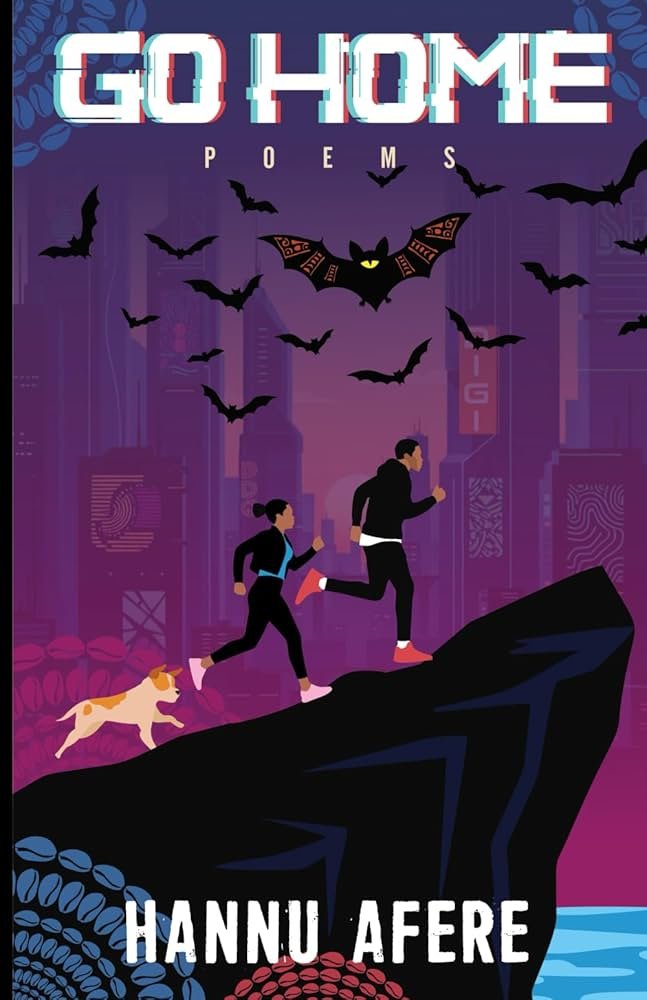
Though Afere has created this world as an isolation from ordinary distractions, only the supposed psychic programming is imaginary. Sociocultural conditions keep close to reality – the police, there’s less direct stanzas about populist presidential hopeful Peter Obi, and the incumbent- the cover illustration centers a cloud of yellow-eyed bats over the edge of a cliff. Man, woman, and dog flee the skyline for the waterfall. I can hear in its purple climate, refrains of the melody at the end of One Last Song to take you Home: /The Water Spirit brought us; the Water Spirit will take us home./
As we proceed, the spirit of the alluded Igbo slaves who chose to drown on arrival resurfaces in the narrator’s judgment. As a vehicle, he fulfils a dutiful role, conveying experiments of spiritual decolonization, negotiating with elemental forces, arresting his situation, and surviving on ancestral wisdom. A few times – moments of hateful rage- Afere breaks the fourth wall and just rants, like a black bear stomping directly at the cake wrapped in metaphors. It is worth noting, as it forms part of the coloring. An Idiot’s Guide to Understanding Why we are Where we Are;
/consider now how these bastards split us into
segments based on dogmas not native to the continent
because people need hope.
And people need fear. And in order to cope,
paper plane escapes; violence is a tool for social engineering.
Allahu Akbar, Shalom and God bless your colonial leaning/
Analogously, /My old man taught me how to make weapons from fine sand, My old man taught me how to shake the thundergod’s hand/ Afere chants in The Importance of Names. He is preoccupied with reconstructing rather than deconstructing. He introduces imagery, auditory effects, memories making bare our base similarities, at least of experience. In this spirit, XOXO starts with the nightly croaking of toads, and one may fill in crickets in the tall grass.
The heavy lifting of sacred language is borne in Yoruba and in some poems, in Igbo. The substance behind idioms is universally identical, and the principles can be superimposed on any flavor of Black spirituality: the hexadecimal system of divination, the naming gates, keen observation of self, and communal continuity. First Principles. He operates West African cosmology in its proper position as the nucleus of mind, judging, rejecting, and expositing from the scientific berth of one whose spirit waited out colonialism and somehow emerged unscathed. This is how the narrator breaks through the neocolonial fascination saddled upon our literature ever since; he ignores it. He writes directly at the cultural issues of the day. In-universe, events unfold unaffected by the whitemen phase, as though it never happened. Even the reasons for the Gods’ return do not directly allege it. That’s what the rants are for. So we do not waste breath grieving spillover from wars whose combatants long died; we know exactly what the day demons are, bats and reflective surfaces, and we foundationally dismantle these. I appreciate the argument behind this technique from (listening to its engagement in a Biafran-Nigerian context on) a panel at Umuofia Arts Festival in 2024. An older artist insisted that progressive generations share less in the suffering, and therefore less to nothing in the actual trauma of wars. A society can bury the memories of a war, as the Germans began to do after 1945. When they hold on to those memories in the arts and in anniversaries, their relationship in position to the event must be deliberately determined so the lessons restore inner esteem and purpose to the future.
The earnestness with which Afere reproduces insight is a landmark in postcolonial protest poetry, polishing his effect via engagement with multiple centers of mind. It has heightened the possibilities of the subgenre. The writing is fanciful, a spread of parentheses, italics, and midsentences. It is rather thrilling watching the rapper dive to connect the bar in uncanny spaces like 1885. Apt neologism is sweet between the lines where ‘iron discipline’, ‘despair more muscular than hope’, ‘old lovers beside deja vu’ reaffirm my love for poetry’s power to bite the heart.
Go Home is Hannu Afere’s first full-length book of poems. Emotionally, he performs an ascent to the vantage of his narrator, to live as he has beheld. He doesn’t fully get there; confessing unwillingness to jump from the deck in 2026, defaulting to Jewish metaphysics a third of the way from the end. Perhaps there were no better parallels? Either way, our spirits need another half-century to completely rid alien debris. We’d better appreciate the fruits of syncretism in this light, as in the limerick Run Golgotha–
they tried to lynch God
strung him up on burning cross
but Ọba Kòso.
Can a culture really be restored after it has been destroyed? We know crashed civilizations reincarnate a second, even third time, dumber. Are we living there already, home, is it this place of eternal in between? This place of no story, no beginning? The poet sees the bleakness; he confesses in the final lines of Simone’s City Lights, Goddam that you don’t really ‘go home’.
*
Ebri Kowaki is a Pan-African,anti-American penman. He is a MAAR 2025 fellow and a culture journalist whose work appears in The Republic, Kurating, Afapinen, Afrocritik, and elsewhere.