
This interview features Nigerian spoken word artist, voice-over professional, and educator Divine Adachukwu Onyekwena (Dee), in conversation with The Iroko Circle, where she reflects on her journey into poetry, her craft, and her creative identity. She speaks about discovering spoken word by accident, after a friend from her debating circle pushed her toward a slam competition she entered without any real preparation or prior knowledge of the form. She touches on the personal roots behind poems like “My Name is Children,” written from the perspective of abused children, and the urgency she feels around preserving Igbo and other Nigerian languages through her programme, Better in Both with Dee. Ultimately, she affirms that creative expression is less about performing for trends or proving oneself to an audience, and more about staying anchored to genuine conviction, embracing every version of one’s voice across different platforms, and trusting that recognition follows authenticity rather than urgency.
The Iroko Circle: Can you just tell us your name, who you are, what you do?
Divine: My name is Divine Adachukwu Onyekwena. In the world of art, I’m known as Dee. I am a spoken word artist, a voiceover artist, an event host, a presenter for an educational program called Better in Both with Dee, and I am a language teacher. I majorly bumped into poetry by accident. However, as time progressed, I’ve come to enjoy, first of all, the process of creating and thinking and coming up with creative things, and I like to share it with people. Over time, I’ve come to realize that it’s more than just entertainment; it’s a powerful tool, which is why I refer to myself as a socially conscious spoken word artist. I enjoy everything that has to do with art, and I love other forms of art, like dance, though I didn’t get that creative expression. With everything I’ve mentioned, I think it’s safe to say that I talk for a living. As for why I am so beautiful, I think that’s my secret recipe.
The Iroko Circle: All right. Thank you very much. One of the things that really caught my attention was how you usually say that you just happened on poetry by accident, yet it has taken you to competitions, festivals, and studios. What did that first performance unlock in you that ordinary conversations never had?
Divine: The first thought I had after that competition was, if I can do this without being adequately prepared for it, imagine what I can do if I’m adequately prepared for it. To be clear, I didn’t even know about spoken word poetry at that time. I was a debater and a public speaker. One of my friends in the debating circle saw a flyer for a slam and told me I should do it since I talk well on stage. I said I didn’t know anything about poetry, as at that time I assumed poetry was all about Soyinka and Shakespeare, which I didn’t like. He told me to go on YouTube, and I saw a poem by Sarah Kay about rape. I could relate to it because of my gender and society. I drew inspiration from that, went to the slam, and came third. That made me realize there was something there. It was just someone saying I should try it because I don’t have stage fright, and I tried it and liked it.
The Iroko Circle: Okay. Thank you very much. Your story looks like mine, just while you were looking at Sarah Kay, I was looking at Propaganda.
Divine: I actually don’t know him.
The Iroko Circle: Oh! Alright, you can check him out later. There’s a striking difference between the voice that sells a brand, the voice that teaches a child, and the voice that warns society about child abuse. How do you decide which version of your voice a particular audience needs to hear?
Divine: I think it just happens naturally. In spoken word poetry, you have to embody the mood or the emotion you’re trying to make your audience feel, using poetic devices and rhythm. That comes easily to me if I’m prepared. Teaching is purely academic to me, so I don’t use poetic devices. Depending on the age range, I’m either playful or more mature, telling stories and cracking jokes to keep them interested. Presenting for the educational program is different again, trying to make people pay attention by being part dramatic and part serious. The different platforms require different voice types, but I don’t mentally switch; I just embody whichever one it is time for.
The Iroko Circle: You know, we’ve come across a couple of your videos, and they are scroll-stopping. One of your Poetry Friday posts asked: “If we damage children before they have the chance to grow, what kind of future are we asking them to create?” When you write about children’s safety, are you trying to persuade adults to protect children or to disturb the comfortable silence between both groups?
Divine: That poem was dedicated to children’s pain. It was at a time when school children were being abducted, and it felt like nobody was doing anything. Children don’t actually have a voice because of the power dynamic, so it is more of trying to persuade the adults. It was an angry poem as a call to action to protect children and stop abuse. It’s trying to tell those with power that they shouldn’t just use it because they have it.
The Iroko Circle: Thank you very much. What does performance allow you to say that writing alone cannot, and what might performance sometimes force you to sacrifice?
Divine: Performance is about the embodiment of the emotions I’m trying to pass across. Sometimes when I finish writing a piece, and someone reads it, they don’t feel it until I voice it. Your poem should make people think, feel, and act. Feeling is key because when people feel, they can move mountains. I don’t think performance hinders me from doing anything. When you’re on stage, it is your voice and your message.
The Iroko Circle: You won the 2025 Enugu Literary Society poetry competition after reportedly arriving simply to have fun. Did that victory change your relationship with competition, or did it confirm that your best work often appears when you are not trying desperately to prove anything?
Divine: I always tell myself that we are going on stage to have fun. There’s a nervousness, but I know I have the charisma and the message. I don’t think I’ve ever climbed a stage to prove something to anyone, except maybe to win the prize money. For that slam, I just wanted to have fun, even though I had a quiet confidence that I was going to win. I’ve never performed to prove myself to anyone.
The Iroko Circle: Okay. I was thinking that at the end of our interview tonight, I’ll do a freestyle for you that you’ll give me 1 million for. Are you game?
Divine: No problem, as long as it is in 3 months.
The Iroko Circle: With Better in Both with Dee, you are not just teaching English and Igbo, but making a statement about identity. Do you see language mainly as a communication tool, a cultural inheritance, or as a kind of emotional home for individuals?
Divine: I think it can be both. Before it feels like home, it is a tool for communication. Being able to communicate creates a sense of belonging. I started the program because I saw a wave of people trying to disassociate from being Igbo. Some people take pride in not knowing how to speak their language. I wanted to teach people that they can be fluent in English and still be fluent in Igbo and still be classy. We associate our own languages with “bush behavior” for no reason. Over the years, I’ve seen a quiet revolution against that mindset. Content creators are using their language and gaining followers. It creates a sense of belonging and associates with home.
The Iroko Circle: Do you think we sometimes attach intelligence or sophistication to speaking English well while treating our indigenous languages as less important? Where does that attitude come from and what do we lose because of it?
Divine: Yes, we associate intelligence with English and even crazier if you have an accent. It’s like a class system between English-speaking cousins and Igbo-speaking cousins. We associate Igbo with dirt or inferiority. It goes beyond language to hair and overall looks. We lose our sense of dignity. This mentality started with colonization and education. In school, you were punished for speaking your language, which diminished it. Now parents are proud when their children don’t speak Igbo. Damage has been done, and many parents have grown up without knowing the language. My best friend in university felt shame for some time for studying the Igbo language. But there’s a quiet revolution of people taking back the narrative. Your culture is your root; anything else is an add-on.
The Iroko Circle: Beautiful mindset. You host red carpets, teach, perform poems about injustice, and record commercial voiceovers. Which of these roles feels most like home and which one demands the greatest acting?
Divine: Teaching in a traditional classroom is the last on the list of feeling like home. Spoken word, event hosting, and presenting are all equal for me. I love being in front of the camera, performing, and hosting. Voiceover acting and traditional teaching require the most out of me. Voiceover requires recording again and again to get the right pitch and avoid errors. Traditional teaching is tasking and draining because you have to keep children disciplined while making sure they learn.
The Iroko Circle: What did you study in school?
Divine: Surprisingly, I studied English Education.
The Iroko Circle: You were born for this. What have you learned from collaboration that you could not have learned by being a performer alone?
Divine: Collaboration makes things easy. At the end of the Building Bridges cohort, I was stressed about a step-down project until Obinna Melody offered to collaborate. That was a huge relief and all the ideas took shape. Imagine two creatives working together to execute a work; it just makes it easier. I’ve had other projects where being included and having others help with things like research for different languages was very helpful.
The Iroko Circle: You’re 6 feet tall and know how to enjoy theatricality. If your personality were a spoken word poem, would the audience meet the serious social critic first or the woman ready to play princess?
Divine: It’s the woman ready to play princess. (laughs). In contrast to how deep or serious my poems sound, the personality you meet is a bubbly, energetic person cracking jokes.
The Iroko Circle: Back to Better in Both with Dee, where did it really come from? Was there a specific moment that pushed you into creating that?
Divine: I speak well, so people assume I don’t know how to speak Igbo. One time, someone was surprised I could speak it. A friend suggested I start a program teaching people how to speak well. I found my “why” and started it, though at first I was very stiff and formal before switching to being more of my bright, fun self.
The Iroko Circle: There’s concern about Nigerian languages fading out. Do you feel that urgency in your work and what is at stake if younger generations don’t pick them up?
Divine: I do feel the urgency. If we let the language go, everything that made us whole will just be nostalgia. It’ll feel like a part of us just left. People stay away for years and eventually have a need to associate with their roots and culture. If we let that go, people are going to try to identify with what they are not.
The Iroko Circle: Social media rewards what is easily consumed. Have you ever found yourself creating something because it would perform well rather than because you genuinely wanted to?
Divine: Sadly, yes. I jumped on a trend to show I was fighting for social justice even though I knew the poem was rubbish and didn’t make sense. It’s embarrassing to force a poem just to trend. Building Bridges taught us about writing because you believe in the cause rather than for trends. Trends will pass; it is your duty to keep talking about the cause even after they do. My best poems are the ones written because I was genuinely inspired.
The Iroko Circle: What is something you are still trying to find the courage to do?
Divine: Moving out of my comfort zone. I grew up safe and have never really taken big risks. I analyze everything too much, so I’m trying to take risks now.
The Iroko Circle: What is something you’re working on that brings you excitement?
Divine: I’m working on getting into the Top 20 for DTH this season. I’m already making costumes and figuring things out. It’s the craziest risk I’ve ever taken, but I’m very excited.
The Iroko Circle: Where can we point our readers to easily find and follow your work?
Divine: On TikTok, I am @6ftofawe, and on Instagram I am dee_onyekwena.
The Iroko Circle: When people hear your work years from now, what do you hope they remember you for most?
Divine: I want people to remember how my words made them feel and act.
The Iroko Circle: What’s one thing you can tell an up-and-coming spoken word poet to give them that fast rising?
Divine: There is no fast rising in spoken word. Be yourself and be the type of poet you want to be. Don’t force yourself to be a spoken word poet just because someone you like is one.
The Iroko Circle: Of everything you’ve created so far, what is your favorite work yet?
Divine: My favorite is a poem I wrote in university in 2018 titled “My Name is Children“. It talks about child abuse from the voice of children. It’s funny coming from someone who didn’t expect to work with children.
The Iroko Circle: Thank you so much for spending time with us today. It’s been a pleasure getting to know you. Tonight your conversation was filled with warmth, fun, honesty, and passion. Thank you.
Divine: Thank you for having me.
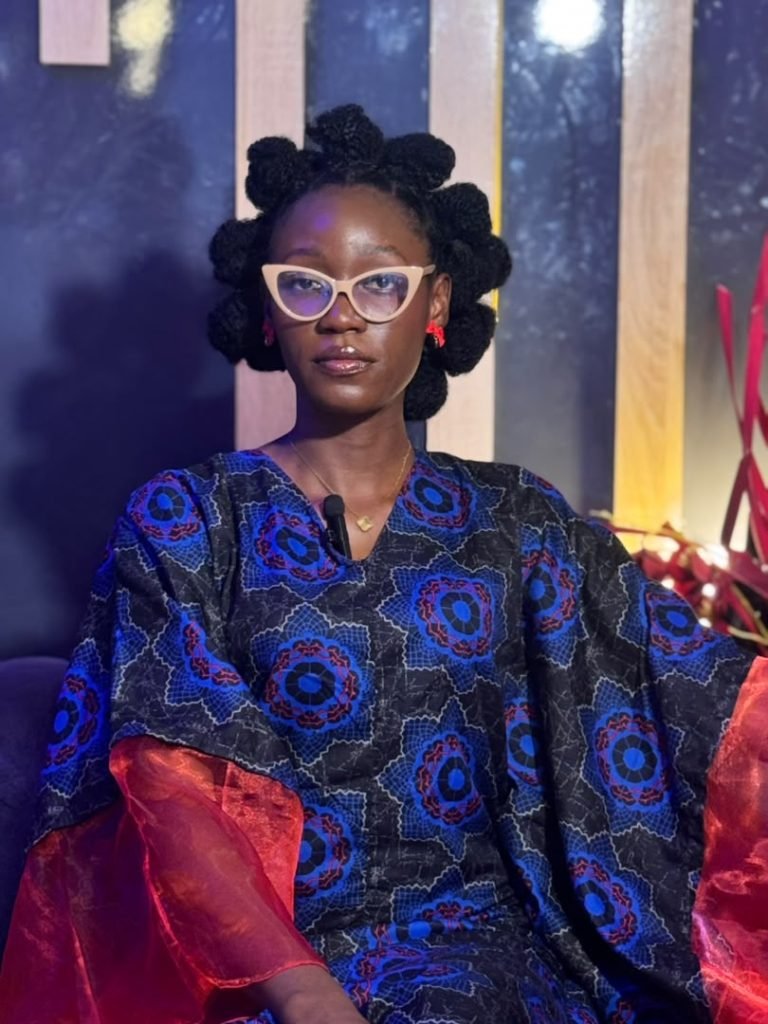
Divine Adachukwu Onyekwena is a spoken word artist, voice-over professional, educator, presenter, and event host. She believes that language is both vocation and calling. Divine is a decorated presence on the slam poetry circuit; she has won multiple competitions and performed across Nigeria and on international stages, crafting work that moves between identity, governance, child rights, and the textures of human connection. She is also the presenter of Better in Both with Dee, an educational programme building proficiency and confidence in both English and Igbo. Being a seasoned educator and event host, she has anchored programmes for schools, organisations, and conferences, and served as a judge for spelling bee and eloquent speech competitions, bringing the same standard of excellence to every platform she occupies.